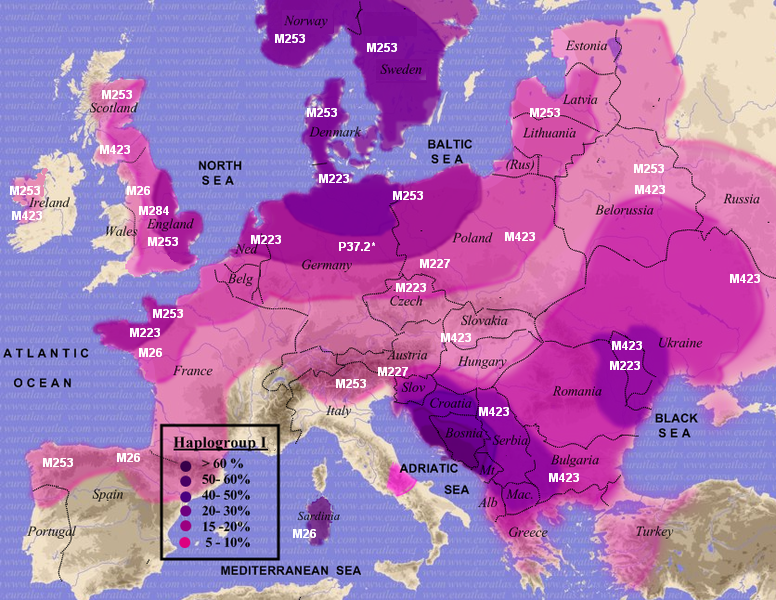
Haplogroup
I2b1
| Surname |
Kit # |
Ysearch
UserID |
SNP
Tests |
Haplotype
— as determined by STR testing |
Known
Lineage |
| Markers 1-12 |
Markers 13-25 |
Markers 26-37 |
Markers 38-67 |
3
9
3 |
3
9
0 |
19
/
3
9
4 |
3
9
1 |
a
|
3
8
5 |
b
|
3
8
5 |
4
2
6 |
3
8
8 |
4
3
9 |
i
|
3
8
9 |
3
9
2 |
ii
|
3
8
9 |
4
5
8 |
a
|
4
5
9 |
b
|
4
5
9 |
4
5
5 |
4
5
4 |
4
4
7 |
4
3
7 |
4
4
8 |
4
4
9 |
a
|
4
6
4 |
b
|
4
6
4 |
c
|
4
6
4 |
4
6
4
d |
4
6
0 |
H4
|
G
A
T
A |
IIa
|
Y
C
A |
IIb
|
Y
C
A |
4
5
6 |
6
0
7 |
5
7
6 |
5
7
0 |
a
|
C
D
Y |
b
|
C
D
Y |
4
4
2 |
4
3
8 |
5
3
1 |
5
7
8 |
a
|
S1
3
9
5 |
b
|
S1
3
9
5 |
5
9
0 |
5
3
7 |
6
4
1 |
4
7
2 |
S1
4
0
6 |
5
1
1 |
4
2
5 |
a
|
4
1
3 |
b
|
4
1
3 |
5
5
7 |
5
9
4 |
4
3
6 |
4
9
0 |
5
3
4 |
4
5
0 |
4
4
4 |
4
8
1 |
5
2
0 |
4
4
6 |
6
1
7 |
5
6
8 |
4
8
7 |
5
7
2 |
6
4
0 |
4
9
2 |
5
6
5 |
| MacLEOD
R1b modal values |
13 |
25 |
14 |
11 |
11 |
14 |
12 |
12 |
12 |
13 |
13 |
29 |
16 |
9 |
11 |
11 |
11 |
26 |
15 |
19 |
31 |
14 |
15 |
15 |
16 |
11 |
11 |
19 |
23 |
16 |
15 |
18 |
17 |
37 |
37 |
12 |
12 |
11 |
9 |
15 |
16 |
8 |
10 |
10 |
8 |
10 |
10 |
12 |
23 |
23 |
16 |
10 |
12 |
12 |
16 |
8 |
12 |
22 |
20 |
15 |
12 |
11 |
13 |
11 |
11 |
12 |
12 |
Modals per DGM (9/2006). |
| |
|
|
|
|
|
|
|
|
| I2b1-Continental-1
modal values |
15/14 |
23 |
15 |
10 |
15 |
15 |
11 |
13 |
11 |
14 |
12 |
31/32 |
15 |
8 |
10 |
11 |
11 |
25 |
14 |
20 |
27 |
11 |
14 |
14 |
15 |
11 |
9 |
19 |
21 |
14 |
14 |
|
|
|
|
12 |
10 |
11 |
8 |
15 |
16 |
8 |
11 |
10 |
8 |
10 |
9 |
12 |
21 |
22 |
15 |
11 |
12 |
12 |
13 |
9 |
13 |
27 |
20 |
11 |
13 |
12 |
12 |
11 |
12 |
12 |
11 |
Modals per Nordvedt (1/2008). |
| I2b1-Continental-1a
modal values |
15 |
23 |
15 |
10 |
15 |
15 |
11 |
13 |
12 |
13 |
12 |
31 |
16 |
8 |
10 |
11 |
11 |
24 |
14 |
20 |
27 |
11 |
14 |
14 |
15 |
11 |
9 |
19 |
21 |
14 |
14 |
|
|
|
|
12 |
10 |
11 |
8 |
15 |
16 |
8 |
11 |
10 |
8 |
10 |
9 |
12 |
22 |
22 |
15 |
11 |
12 |
12 |
13/14 |
9 |
13 |
27 |
20 |
11 |
13 |
12 |
12 |
11 |
12 |
12 |
11 |
Modals per Nordvedt (1/2008). |
| I2b1-Continental-2a
modal values |
14/15 |
23 |
15 |
10 |
15 |
15 |
11 |
13 |
11 |
13/14 |
12 |
31/32 |
15 |
8 |
10 |
11 |
11 |
25 |
14 |
20 |
27 |
11 |
14 |
14 |
15 |
11 |
10 |
19 |
21 |
15 |
14 |
|
|
|
|
12 |
10 |
11 |
8 |
15 |
16 |
8 |
11 |
10 |
8 |
10 |
9 |
12 |
21 |
22 |
15 |
11 |
12 |
12 |
14 |
9 |
14 |
|
20 |
11 |
13 |
12 |
12 |
11 |
12 |
12 |
11 |
Modals per Nordvedt (1/2008). |
| |
|
|
|
|
|
|
|
|
| RASEY |
69631 |
45ZVC |
|
14 |
23 |
15 |
10 |
15 |
15 |
11 |
13 |
11 |
14 |
12 |
33 |
16 |
8 |
10 |
11 |
11 |
25 |
14 |
20 |
27 |
11 |
14 |
14 |
15 |
11 |
10 |
19 |
21 |
14 |
14 |
17 |
17 |
36 |
39 |
12 |
10 |
11 |
8 |
15 |
16 |
8 |
10 |
10 |
8 |
10 |
10 |
12 |
21 |
22 |
16 |
11 |
12 |
12 |
14 |
9 |
13 |
28 |
18 |
11 |
13 |
12 |
12 |
11 |
12 |
12 |
11 |
Pvt7, Donald Elza6,
Ira
Cornelius5, John
C.4,
Joseph3,
John2,
Joseph
RASEY I1 |
| |
|
|
|
|
|
|
|
|
| RAZEE |
70816 |
99R47 |
|
15 |
23 |
15 |
10 |
15 |
15 |
11 |
13 |
11 |
14 |
12 |
31 |
16 |
8 |
9 |
11 |
11 |
25 |
14 |
20 |
27 |
11 |
14 |
14 |
15 |
11 |
9 |
19 |
21 |
14 |
14 |
18 |
18 |
32 |
40 |
12 |
10 |
11 |
8 |
15 |
16 |
8 |
11 |
10 |
8 |
10 |
10 |
12 |
21 |
21 |
16 |
11 |
12 |
12 |
13 |
9 |
13 |
27 |
20 |
11 |
13 |
12 |
12 |
11 |
12 |
12 |
11 |
Pvt6, George
Dallas5, Benjamin4,
Anthony3,
Benjamin2,
Joseph
RAZEE I1 |
| RASEY |
110919 |
|
|
15 |
23 |
15 |
10 |
15 |
15 |
11 |
13 |
11 |
14 |
12 |
31 |
15 |
8 |
9 |
11 |
11 |
25 |
14 |
20 |
27 |
11 |
14 |
14 |
15 |
11 |
9 |
19 |
21 |
14 |
14 |
18 |
18 |
34 |
40 |
12 |
10 |
|
|
|
|
|
|
|
|
|
|
|
|
|
|
|
|
|
|
|
|
|
|
|
|
|
|
|
|
|
|
Pvt9, Pvt8,
Isaac
S.7, Norval
Adelbert6, Edward
Arnold5, Aaron4,
Joseph3,
Joseph2,
Joseph
RAZEE1 |
| |
|
|
|
|
|
|
|
|
| The three above test subjects have haplotypes resembling the
Continental varieties of Haplogroup I2b1 defined
by Nordtvedt,
although none falls clearly into any one of its sub-varieties. |
| #69631 has only a 54/67 match with #70816 (genetic distance 18) and
a 25/37 match with #110919 (genetic distance 11), which means despite the
coincidence of all three being I2b1-Continental, they are not closely related,
at least not in "genealogical time." Certainly, they are not closely
related enough for Joseph RASEY I to have been the son of Joseph RAZEE
I, so we can consider that assertion disproven. He has a few matches
at 12 and 25 markers, all outside his surname, but his haplotype is unique
at 37 or 67 markers, with no full or even near matches in either the FTDNA
or Ysearch databases. Please see the textboxes to the right for a
discussion of the MacLEOD comparison. |
| #70816 and #110919 have a paper descent from Joseph RAZEE I, and they
match each other 35/37 (genetic distance 3), with all the differences being
on fast-mutating markers. This result is consistent with them having
a near common ancestor and supports their paper connection. They
have a couple dozen full matches at 12 markers and a handful of full matches
at 25 markers, all outside their surname, but their haplotype is unique
at 37 or 67 markers, with no full or even near matches in either the FTDNA
or Ysearch databases. |
|
| Knowing just the haplogroup, alone, is enough to debunk the legend
of a connection between Joseph RASEY I and Malcolm MacLEOD of the Isle
of Raasay, Scotland, whose kin are Haplogroup
R1b — or to any other
MacLEOD lineage so far tested for the MacLEOD project. People in
different haplogroups cannot have had a common ancestor for thousands
of years. And given that the MacLEODs are different haplogroups
from our subject, we wouldn't expect their haplotypes to match or
be even close to our subject. This expectation is overwhelmingly
realized by comparing the Joseph RASEY descendant's haplotype to the modal
R1b marker frequencies in the MacLEOD project (see above). They have
a mere 0/12, 3/25, 7/37, or 22/67 correspondence — a
resounding
non-match! |
| If you examine the
Y-DNA test results at the MacLEOD web site, you will note most of the
subjects are R1b, with a sizable number also being R1a, which indicates
that the surname has at least two different, unrelated progenitors.
There are, no doubt, some additional separate lines within each haplogroup,
which we would expect for any surname that is derived from a patronymic.
In other words, not everyone surnamed MacLEOD will be a descendant of Leod,
Chief I — though Malcolm MacLEOD of Raasay supposedly is. |
| You will also note that among MacLEOD test results (as of 25 May 2008)
just nine individuals are not R1a or R1b, specifically: one is E3b
and eight are I1. Not one test subject in the MacLEOD project
is Haplogroup I2, so no recent connection to our RASEY line is even
remotely possible with any MacLEOD so far tested. And, most importantly,
the progenitor to whom our Joseph RASEY is supposedly connected (viz.,
Leod, Chief I) has been well-tested by many purported descendants, and
we are simply
not related to them. I'm sorry, but the legend
of Joseph RASEY's origin as a MacLEOD of Raasay is just that, a fanciful
legend — one that is untrue. |
|
Return to
Project Home Page |